The Ultimate Guide to Cable and Hose Management in Harsh Environments
Whether you’re managing a high-traffic construction site, a busy woodworking shop, or an outdoor event, the "cable octopus" is more than just an eyesore—it’s a safety hazard and a budget killer. In clean, climate-controlled offices, cable management is about aesthetics. In the mud, dust, and UV glare of the real world, it’s about survival.
Neglecting your power leads and pneumatic hoses in harsh conditions leads to "phantom" shorts, trip hazards, and the premature death of expensive equipment. This guide explores professional strategies to keep your cords organized, your site safe, and your workflow optimized.
1. Why Traditional Cable Management Fails Outdoors
Many people reach for plastic zip ties, electrical tape, or hook-and-loop straps when things get messy. In a dirty or outdoor environment, this is a mistake.
- The "Blade" Danger: To remove a zip tie, you need a knife. In a dark shop or a muddy field, one slip can slice through the insulation of a $100 heavy-duty extension cord.
- UV Degradation: Standard plastic ties become brittle and snap after just a few weeks of sun exposure.
- Adhesive Failure: Electrical tape turns into a gooey, sticky mess when exposed to heat or sawdust, leaving a residue that actually attracts more dirt to your cables.
- Hook-and-loop clogging: Hook-and-loop straps rely on clean fibers to stick together. But job sites aren’t always clean. That’s why hook-and-loop straps are often ruined as soon as they hit the dirt. Or dust. Or fuzz.
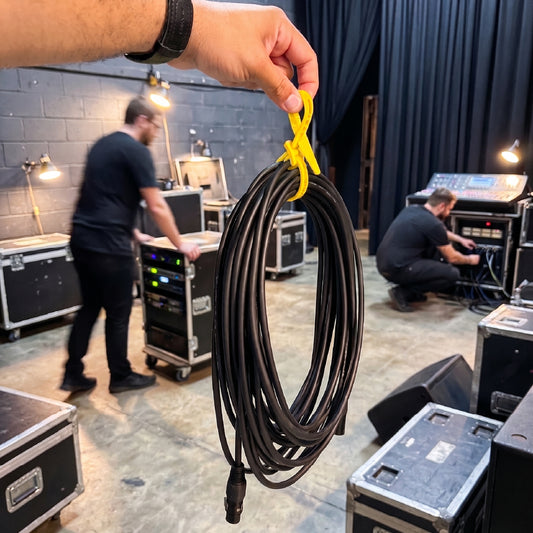
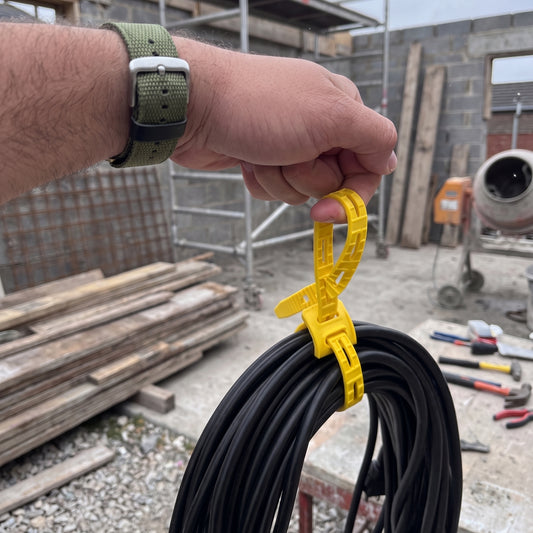
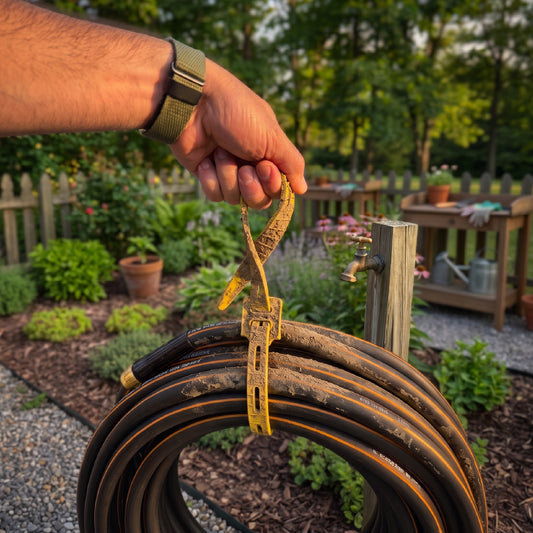
The Solution: Use industrial-grade straps. Look for Cord-Tie which is designed for outdoor use. They are durable, reusable, and versatile. Cord-Tie holds up to dirt, debris, fuzz, weather, water, and they’re UV resistant.
2. Elevate to Eliminate Hazards
In a workshop or outdoor site, the ground is the enemy. Water, mud, and metal shavings are drawn to electrical connections.
- Under-Bench Routing: For workbenches, apply a long strip of "loop" adhesive tape along the back rail. Use small "hook" tabs on your tool cords to "click" them up and out of the way of your feet.
- Sky-Hooking: On job sites, use "S-hooks" or specialized heavy-duty hangers to route main power trunks along rafters or fence lines.
- The "Drip Loop": If a cord must go from a high point to a tool, ensure there is a small "U-shaped" dip before the cord enters the tool or the outlet. This ensures that rainwater or liquid flows to the bottom of the loop and drips off, rather than running directly into the electrical socket.
3. Visual Mapping and Color-Coding
When you have six identical black pneumatic hoses running to a single compressor, troubleshooting a pressure drop becomes a guessing game.
- Assign Colors: Use colored hook-and-loop ties at both ends of every lead. Blue for the sander, red for the table saw, green for the air nailer.
- Labeling: For professional sites, use heat-shrink tubing with printed labels before you attach your connectors. This provides a permanent, waterproof ID that won't peel off in the rain.
4. Strain Relief: Protecting the Connection Point
The most common point of failure for any cord or hose is the "strain relief boot"—the spot where the wire enters the tool or the plug. In dusty environments, grit gets trapped in these boots and acts like sandpaper, eventually fraying the wires.
The Pro Hack: Use a Cord-Tie to "tether" the cord to a fixed point (like the leg of a workbench or a secondary handle) about 10 inches away from the connection. This ensures that if someone trips on the cord, the force pulls against the strap and the tool's frame, rather than the delicate internal electrical terminals.
5. Managing Hoses vs. Electrical Cords
While they look similar, hoses (air and water) have different requirements:
- Temperature Sensitivity: Air hoses can become "memory-locked" in cold weather. Always store them in larger loops (24+ inches) during winter to prevent cracking.
- Pressure Checks: Never bundle high-pressure hydraulic hoses tightly with electrical cords. If a hose leaks, the high-pressure fluid can "pinhole" through electrical insulation, creating a fire risk. Keep "wet" and "dry" lines separated by at least 6 inches whenever possible.
Summary: Best Practices for Site Safety
Effective cable management in dirty or outdoor environments isn't just about being "tidy"—it’s a critical component of OSHA compliance and operational efficiency. By switching to reusable straps and elevating your lines, you reduce downtime and prevent costly accidents.
Key Checklist:
- Use mud and UV-resistant Cord-Tie instead of zip ties.
- Use Drip Loops to keep moisture out of connections.
- Color-code leads for fast troubleshooting.
- Provide Strain Relief to extend tool life.