The Silent Productivity Killer: A Guide to Industrial Cable and Hose Management
In the high-speed world of modern manufacturing, plant managers often obsess over Lean methodologies, Six Sigma metrics, and the latest Industrial IoT sensors. Yet, one of the most significant threats to safety and uptime is often right underfoot—or dangling precariously overhead.
Cables, power cords, and pneumatic hoses are the nervous system of any facility. However, without a rigorous management strategy, they quickly turn into a chaotic "spaghetti" of hazards. Effective cable management isn't just about tidiness; it’s a fundamental pillar of operational excellence.
The Real Cost of Poor Cable Management
Before implementing a solution, it’s vital to understand the financial and operational stakes. In a manufacturing environment, cables and hoses are subjected to harsh conditions: extreme temperatures, chemical exposure, constant vibration, and physical abrasion. If left unmanaged, three significant issues arise:
- Safety Hazards & OSHA Compliance: Slips, trips, and falls consistently rank among the top OSHA violations. A stray air hose or an extension cord stretched across a walkway is a massive liability.
- Unscheduled Downtime: Cables that are stepped on or driven over by forklifts suffer internal fractures. Constant tension on a connector leads to intermittent signals and hard-to-diagnose machine errors.
- Increased MTTR: If a technician spends forty minutes tracing a single hydraulic line through a cluttered tray just to perform a simple repair, your Mean Time to Repair (MTTR) skyrockets.
Applying the 5S Methodology to Cable Organization
The 5S framework (Sort, Set in order, Shine, Standardize, Sustain) is the gold standard for shop floor organization. Here is how to apply it to your wiring:
- Sort: Identify and remove legacy cables or hoses from decommissioned machinery. If a cord isn't powering a live asset, it shouldn't be in the tray.
- Set in Order: Every line should follow a logical, documented path. Use cable labels at both ends of every cord to ensure immediate identification.
- Shine: Clean cables and hoses regularly. Dust and oil buildup can act as an insulator, causing cables to overheat and potentially ignite.
Essential Industrial Management Methods
Management is impossible without the proper infrastructure. Relying on "temporary" zip ties is a common mistake; they often cut into cable jackets and are difficult to remove during upgrades. Instead, consider these industrial-grade solutions:
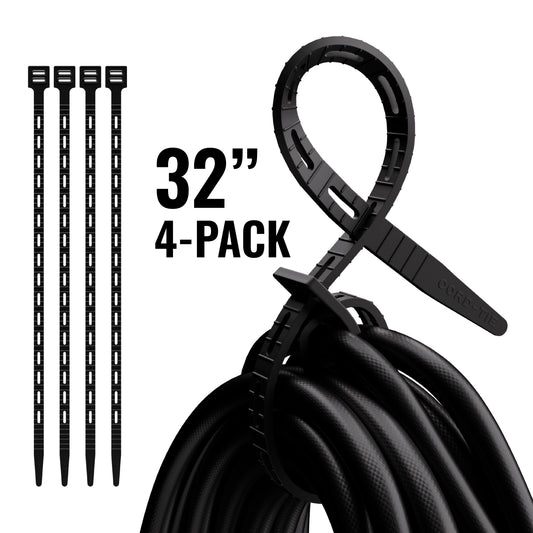
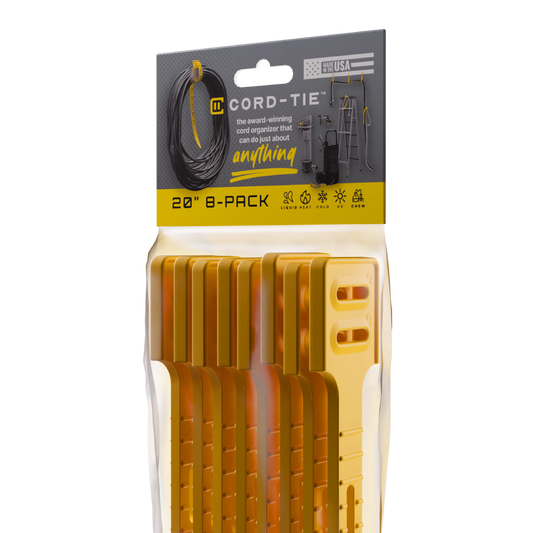
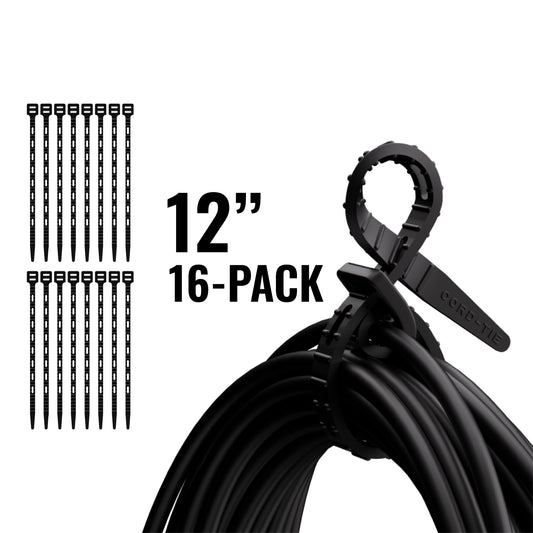
Cord-Tie
A durable, reusable, and versatile tool for bundling cables, cords, and hoses, Cord-Tie is designed for professional environments. Unlike hook-and-loop straps, Cord-Tie holds up to chemicals, dirt, debris, water, and weather. It’s reusable unlike zip ties. And it doesn’t leave a residue like tape can.
Cable Carriers and Drag Chains
For automated machinery where cables must move constantly (like CNC machines or robotic arms), drag chains are essential. They prevent twisting and ensure that the bend radius of the cable is never exceeded, preventing internal wire fatigue.
Drop-Down Retractable Reels
The floor should be kept as clear as possible. Retractable reels for air hoses and power cords allow operators to pull down what they need and snap it back out of the way when the task is complete.
Cable Trays and Raceways
For permanent installations, overhead cable trays keep high-voltage and data lines separate. Separation is crucial to prevent electromagnetic interference (EMI), which can cause data corruption in sensitive PLC systems.
Strategic Routing: The "Right Angles" Rule
A professional facility avoids "diagonal" routing. Running cables diagonally across a space might save a few feet of wire, but it makes the layout confusing and harder to protect.
- Parallel and Perpendicular: Always run lines along the walls or ceiling at 90-degree angles.
- Protection at Floor Level: Where cables must cross floor space, never leave them bare. Use heavy-duty rubber cord protectors or "bridge" ramps capable of sustaining forklift traffic.
Conclusion: A Culture of Tidiness
Ultimately, the most expensive cable management system in the world will fail if the culture doesn't support it. Management must prioritize the "Sustain" portion of the 5S cycle. This means conducting regular "cord audits" and empowering operators to report frayed jackets or sagging lines immediately.
By treating your cords and hoses with the same respect as your primary production assets, you create a safer, more professional, and significantly more profitable environment. Don't let the "spaghetti" under the workbench eat into your margins—clean it up, tie it down, and keep the floor clear.